Best 12 Patient Care Technician Jobs for Nursing Students in Florida: Picture this. It’s 11 p.m. on a Tuesday. You’ve just finished a four-hour study block on fluid and electrolyte balance. Notes color-coded. Practice quiz scores solid. And yet, sitting in that quiet apartment, you have this nagging feeling that something isn’t clicking like you’re absorbing the textbook version of nursing without ever quite inhabiting the real one.
That feeling is more common than you think. And it has nothing to do with how smart you are.
It’s the gap between knowing what a deteriorating patient looks like on paper and knowing what it feels like to be in the room when it happens. No case study closes that gap. Only the bedside does. That’s exactly why working as a Patient Care Technician while you’re still in nursing school isn’t just a smart financial move it’s the closest thing to a clinical fast-track that exists. Florida makes this especially worth pursuing. The state has one of the largest healthcare landscapes in the country massive hospital networks, specialty cancer centers, busy emergency departments, a huge aging population, and consistent demand for skilled patient care staff. For nursing students, this isn’t a tough market to break into. It’s a market that’s actively looking for you.
Key Takeaways:
- Florida’s healthcare market is large, consistent, and structured around nursing students this is a good time to be looking.
- Most PCT roles require a CNA and nursing school enrollment credentials you likely already have or are weeks away from completing.
- Where you work matters as much as what you do every setting builds a different clinical instinct.
- The right PCT job won’t just pay your rent. It will shape the kind of nurse you become.
What Is a Patient Care Technician and Why Does the Role Matter?
A Patient Care Technician works directly with patients under nurse and physician supervision. On any given shift, you might be checking vitals, drawing blood, running a 12-lead EKG, or helping a post-surgical patient sit up for the first time since their procedure. The tasks vary by setting but the common thread is that you are always close to the patient, always inside the clinical action.
Here’s what most nursing students get wrong: they treat PCT work as something to endure around school, not something to use because of school. The students who extract the most from these roles walk into every shift with a specific thing they’re watching for. One question. One skill. That intention is the difference between clocking hours and actually growing.
Why Florida Is One of the Best Places to Pursue This
You’ve probably heard that healthcare is growing. But the scale of what’s happening in Florida is worth a closer look. The state’s population skews older than the national average, its major metro areas Miami, Tampa, Orlando, Jacksonville each run multiple competing hospital networks, and a year-round tourism industry generates a steady undercurrent of acute care demand that most states simply don’t have.
The numbers back this up: according to the U.S. Bureau of Labor Statistics, healthcare support occupations are projected to grow 14 percent between 2023 and 2033 faster than almost every other occupational category. For nursing students, this means PCT openings in Florida are not seasonal or scarce. What’s harder is finding the right one because not all patient care technician jobs build the same skills.
Before You Apply Anywhere: The 3-Filter Method
Most nursing students pick PCT jobs the way most people pick restaurants on a Friday night whatever’s available, whatever’s close, whatever takes them. Before you submit a single application, run every role through these three questions:
Filter 1: Does this role stretch me clinically?
If you could do it confidently on day one with minimal anxiety, it’s maintenance not growth. The best PCT role sits just outside your current comfort zone. Not so far it’s unsafe. Far enough that it demands your attention.
Filter 2: Does this setting align with where I want to go?
Think of PCT work as an extended audition for your specialty. If you’re leaning toward critical care, two years in a low-acuity outpatient clinic tells you almost nothing about whether you’ll thrive in an ICU. Two years in an ED or telemetry unit tells you and future employers a great deal.
Filter 3: Can my schedule actually handle this?
Burning out by midterms because your PCT shifts are too intense isn’t a learning experience it’s a scheduling mistake. Heavy clinical blocks call for steadier settings. Lighter semesters are when you push harder.
These three filters take five minutes to apply. They can save you a year of working somewhere that isn’t actually building the future you’re after.
The 12 Best Patient Care Technician Jobs for Nursing Students in Florida
1. Hospital PCT HCA Florida Healthcare Network
HCA Florida’s network spans Tampa, Brandon, Fort Pierce, West Palm Beach, and Ocala. Many locations structure PCT hiring specifically around nursing students built-in scheduling flexibility, tuition assistance, and the expectation that you’re managing a course load alongside your shifts. Some facilities require only Nursing Fundamentals completion to qualify.
2. Emergency Department PCT
If you’ve ever wondered how you’d hold it together when three things go wrong at once, an ED role answers that fast. Trauma activations, cardiac alerts, pediatric crises the compressed decision-making here builds clinical instincts you cannot get anywhere else. Hospitals across Miami-Dade, Broward, and Hillsborough post ED openings regularly.
3. Telemetry Unit PCT
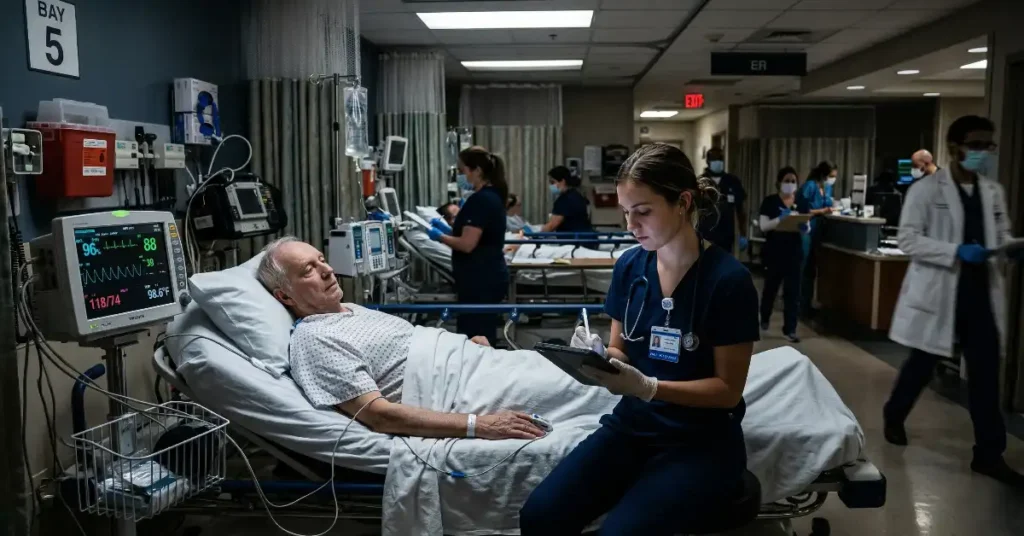
Every patient on continuous cardiac monitoring. Part of your job is spotting a rhythm change before the nurse does. You’ll run EKGs and spend shifts with nurses who think in waveforms and intervals. For anyone heading toward cardiology or critical care, there’s no better early foundation.
4. PCT at H. Lee Moffitt Cancer Center, Tampa
One of the top-ranked cancer hospitals in the country, right in Tampa. Working here means supporting patients through chemotherapy, post-surgical recovery, and new diagnoses. What Moffitt builds that most settings can’t is emotional steadiness the ability to be present with a patient’s fear without absorbing it. Oncology nurses say it’s one of the hardest qualities to develop. Starting early matters.
5. Long-Term Care and Skilled Nursing Facility PCT
Unfairly dismissed. LTC patients are medically complex strokes, joint replacements, wound care — and the depth of patient relationship you build here is something hospital-based care rarely allows. Scheduling is also more predictable, which matters when you’re balancing clinical rotations and exams.
6. Home Health PCT
No charge nurse down the hall. No crash cart around the corner. Just you, the patient, and whatever clinical judgment you’ve built so far. That mild pressure accelerates independent thinking faster than almost any institutional setting. For students a few semesters in who want to test what they actually know, home health is where you find out.
7. Outpatient Clinic PCT
Monday through Friday, no rotating shifts a genuine option when you’re sitting for your pharmacology final this Thursday. Patient intake, vitals, phlebotomy, basic wound care. Many students use outpatient experience to stop being nervous about the basics, so when they step into a hospital they’re only nervous about things worth being nervous about.
Match Your PCT Role to the Nurse You’re Trying to Become
Most nursing students apply broadly and hope something sticks. This table maps your specialty interest to the setting that builds the most relevant foundation and flags the one mistake most students make in each environment.
| Nursing Interest | Best PCT Setting | What You’ll Build | Mistake to Avoid |
| Critical Care / ICU | Emergency Dept. | Composure, triage instincts | Double shifts until you burn out by midterms |
| Cardiology | Telemetry Unit | EKG fluency, rhythm recognition | Staying comfortable too long without pushing |
| Oncology / Palliative | Cancer Center (Moffitt) | Emotional endurance, presence | Not anticipating how draining this will feel |
| Psych / Mental Health | Behavioral Health | De-escalation, therapeutic comms | Expecting it to run like a medical floor |
| Surgical / Perioperative | Pre-Op / Post-Op | Procedural precision, recovery monitoring | Writing it off as ‘not hands-on enough’ |
| Geriatrics / Med-Surg | LTC / SNF | Patient rapport, documentation depth | Treating LTC as a consolation prize |
| Community / Primary Care | Outpatient Clinic | Time management, preventive care basics | Defaulting to it when you could handle more |
8. Academic Medical Center PCT
UF Health Shands, Tampa General (USF Health), Jackson Health System in Miami. These institutions carry a culture where questions are expected, not just tolerated. You’ll work near residents and fellows, see case complexity community hospitals rarely handle, and absorb a systems-level view of care that changes how you think before you graduate.
9. Rehabilitation Center PCT
Patients recovering from strokes, hip replacements, spinal injuries working toward goals measured in inches and minutes. You’ll coordinate with physical and occupational therapists and track slow, nonlinear progress across weeks. For students interested in med-surg, neuro, or case management, this cross-disciplinary exposure is genuinely hard to replicate.
10. Behavioral Health PCT
Psychiatric units teach you to communicate when communication is the only tool you have. No procedure to fall back on when a patient is escalating. You learn to slow your breathing, choose words deliberately, and stay regulated when the person in front of you isn’t. Those skills follow you into every nursing specialty you’ll ever work in.
11. Surgical Services Pre-Op and Post-Op PCT
Focused, precise, unforgiving of distraction. You’ll prep patients before procedures and monitor them surfacing from anesthesia watching for pain, nausea, bleeding, the subtle post-op signs that something isn’t right. For students considering surgical nursing or eventually a CRNA pathway, this is one of the most direct early windows into that world.
12. PCT Placement Through USAIT Career
You know you want a PCT role. You know roughly what setting fits. But applying to individual hospital portals feels like shouting into a void applications disappear, follow-ups go unanswered. USAIT Career matches you to active openings based on your credentials, schedule, and location. The time you save not chasing job boards goes straight back into your studies.
What Do You Need to Qualify? A Checklist for Florida PCT Applicants
The bar to entry is closer than most students assume. Here’s what Florida PCT employers typically want before making an offer:
- High school diploma or GED
- Florida CNA certification issued through the Florida State Board of Nursing
- Active enrollment in an accredited nursing program
- Completion of Nursing Fundamentals (required by select hospital systems verify before applying)
- Clean background check, drug screening, and required immunizations
- CPCT/A certification through the National Healthcareer Association (preferred a clear differentiator in competitive markets like Tampa and Miami)
- Reliable transportation and consistent shift availability
What Two Years of Intentional PCT Work Can Actually Look Like
The students who get the most from PCT work aren’t the ones who perform the most tasks. They’re the ones who pay attention to what’s happening around the task. Why did the nurse pause before entering the room? What did she notice in the patient’s face before she checked the chart? Those micro-observations are the real curriculum. The vital signs are just the reason you’re in the room.
Frequrntly Asked Questions(FAQs)
How does USAIT Career help nursing students find PCT jobs in Florida?
USAIT Career matches nursing students to active PCT openings based on their certification level, schedule, and preferred location cutting through the frustration of hospital portals that rarely respond to first-time applicants.
What kinds of PCT roles does USAIT Career typically list for Florida nursing students?
USAIT Career covers a wide range of clinical settings hospital floors, telemetry units, outpatient clinics, long-term care, behavioral health, and more so students can find roles that fit both where they are in their program and where they want to end up.
What makes a good PCT role for someone still in nursing school?
The best role stretches you clinically, aligns with your intended specialty, and fits your schedule. All three is the goal. Two out of three is worth considering. One out of three keep looking.
What are the best practices for balancing PCT shifts with a full nursing course load?
Match shift intensity to your semester. Push into higher-acuity settings during lighter academic blocks; pull back during heavy clinical rotations or exam periods. Build in one non-negotiable rest day consistency at work requires recovery.
What are the current trends in PCT hiring for nursing students in Florida?
Florida hospital systems are increasingly building PCT pipelines around nursing student availability structured scheduling, tuition assistance, and CPCT/A certification support are becoming standard at major networks.
